3d drawing of a planer-shaper gauge
Gauge Measurement & Gauge vs Cuff Spellings
This is simply a quick aside to talk about the word "Judge" which has two spellings for machinists–"Gauge" and "Cuff".
In the strictest sense, a Gage is a Measurement Device that acts as a standard. We employ it comparatively. For instance, a Cuff Block is a rectangular piece of metal that has a certain length known with great accuracy. We can utilise information technology to measure that one length (or past combing with multiple Gage Blocks, multiple lengths). That'south Gage Measurement.
A Caliper, on the other paw, tin can read many different lengths.
This distinction is non at all difficult and fast. In fact at that place are many Measuring Devices that are chosen Gages only don't act at all like i in the sense they mensurate many dimensions. A Acme Cuff or Depth Gage would be ii skillful examples.
Don't get too wrapped up in the discussion. Simply be aware it refers to measurement and that either spelling is right.
Measuring Tools for Length or Thickness
Digital Caliper Consummate Guide [ Vernier, Dial, Best Ones, and More ]
Calipers are probably the most common measuring tool for length or thickness. There are a number of types beyond just digital including vernier, dial, inside, and outside calipers. We've got a consummate chapter written that takes you through all aspects of Calipers:
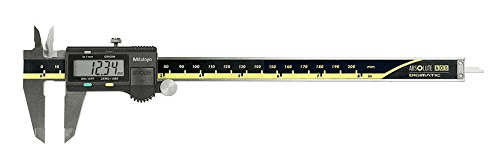
Digital Caliper Complete Guide [ Vernier, Dial, Best Ones, and More ]
Micrometer
When a pair of calipers just isn't authentic enough (i.e. need to mensurate a tolerance that is less than 0.002″), most machinists volition plow to a Micrometer. They come up in digital, dial, and vernier styles, much like calipers:
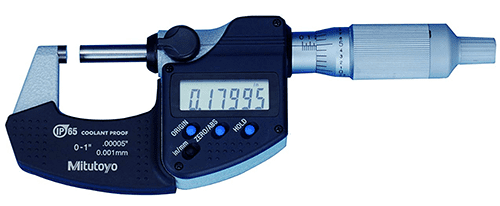
Mitutoyo Digital Micrometer…
Check our Easy Guide to Micrometer Reading, Utilise & Measurement for full details:
Like shooting fish in a barrel Guide to Micrometer Reading, Use & Measurement
Dial Exam Indicators & Dial Indicators (DTI, Dial Gauge, Digital Dial Indicator, Digital Dial Gauge)
First, what's the deviation between a Punch Indicator and a Dial Test Indicator?
Information technology'due south pretty uncomplicated. The Punch Indicator has a plunger and reads how far the plunger is raised past the surface beneath. The Dial Examination Indicator has an arm that sweeps an bending. It measures how far the arm is pushed sideways. Both are handy, but you lot'll tend to use a Dial Test Indicator more than oftentimes.
These photos should make the differences clear:
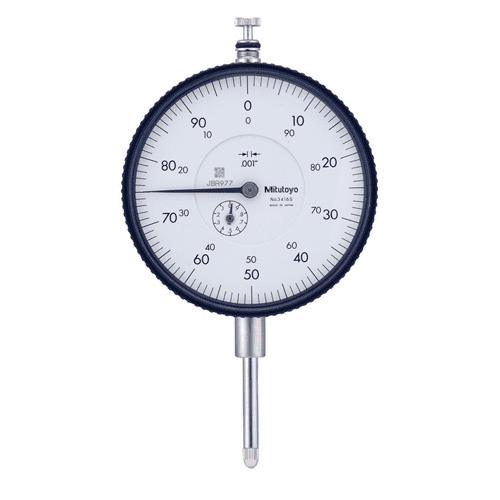
Mitutoyo Dial Indicator reads how far plunger moves upwards to nearest thousandth of an inch (0.001″)…
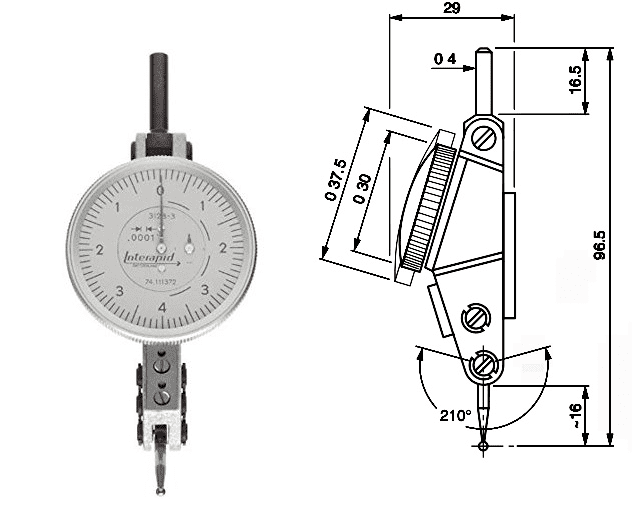
Interapid Punch Test Indicator, Tenths Accuracy (0.0001″)…
Easy Guide to Dial Indicators & Punch Test Indicators
Height Gauge
A Superlative Gauge and Granite Surface Plate should exist one of your earliest investments in Metrology Tooling. I got mine right later on Digital Calipers and Micrometers.
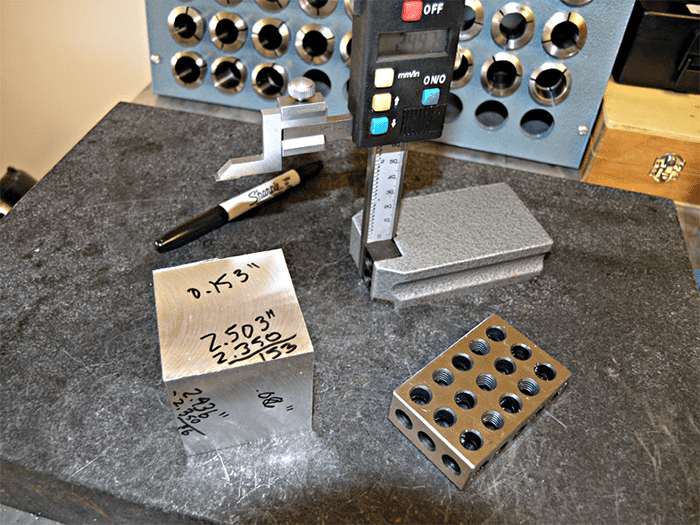
Measuring a workpiece with elevation gage and granite surface plate for a Turner'due south Cube…
Elevation Gauge Complete Guide
Planer Gage & Adjustable Parallels
Sometimes you lot want to capture a detail distance, and utilize it to prepare another tool upwardly. You can accept great intendance setting it up with precision measuring devices, then you just want to lock it downwardly and transfer to where it volition be used. Frequently the place it will be used is no place for precision measure out devices. There'southward either not enough room, it's as well muddy, or some such.
When I think of applications like this, I recall of Planer Gages and Adjustable Parallels.
Planer Gage (Planer Guess, Planer Shaper Gauge)
Here's a typical Planer Gage past Fowler:
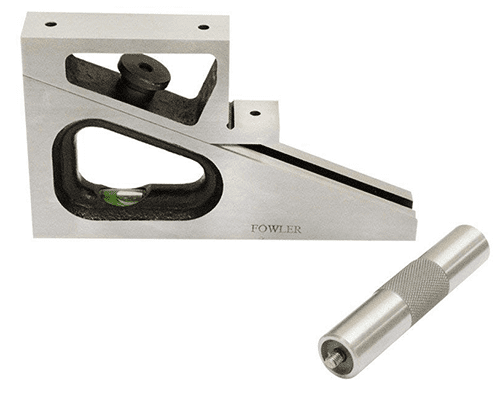
Planer Gage past Fowler. Nigh $59.88 on Amazon.
Using one couldn't be simpler. Fix it on the bottom surface to be measured. Unlock the locking thumbscrew and slide until one of the surfaces on the sliding slice is the right distance from the bottom, possibly because it has come into contact with what you're measuring. At present you can take it back to your surface plate and summit gage to see what the measurement is. Or mic information technology or use calipers, whatsoever is convenient and offers enough accuracy for your purposes.
You tin also do the reverse. Set the Planer Gage up to a precise altitude, take information technology to the setup, and use it as a stop that is exactly the right distance for your purpose.
Other uses:
- As an adaptable Gage Block on a Sine Bar.
- Setting tool meridian on lathe tools. They're called planer shaper gages because they were originally used to set tool height on those machines.
- Every bit an adaptable machinist's jack, especially if the summit is to be precisely controlled for a setup that will exist repeated.
Adaptable Parallels
Adjustable parallels are very similar in office to a Planer Cuff, merely they're much more compact and fit into smaller spaces. I tend to utilise the Planer Gage when I want to stand it upwards and Adaptable Parallels when I want to lay them down.
Hither's a nice Starrett ready of Adaptable Parallels:
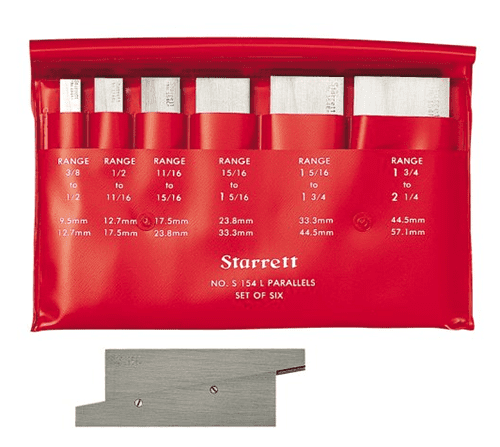
Starrett Adaptable Parallels. Virtually $266.31 on Amazon…
You tin can become cheaper sets past either choosing cheaper brands or a gear up with fewer parallels.
Edge Finders, 3D Sensors, and Coaxial Indicators
If y'all use a milling machine, you will need to be able to observe edges, corners, and hole centers. This is all part and parcel of setup work on these machines. Often information technology'due south done to locate Part Cypher, so exist sure to also bank check out our article on all the different means yous tin can locate Part Zero.
Hither'south a typical mechanical edge finder:
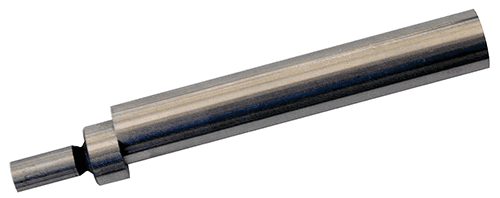
Mitutoyo Mechanical Edge Finder. Near $12.77 from Amazon...
To see how all these measuring tools work, bank check out our complete guide:
Complete Guide to Edge Finders, 3D Tasters, and Center Finders
Measurement References
At some signal, before you get as well far along collecting measurement tools, you will want some precision Measurement References. These are measuring tools whose size is known with very loftier precision. They can exist used for calibration and various other purposes.
Surface Plate
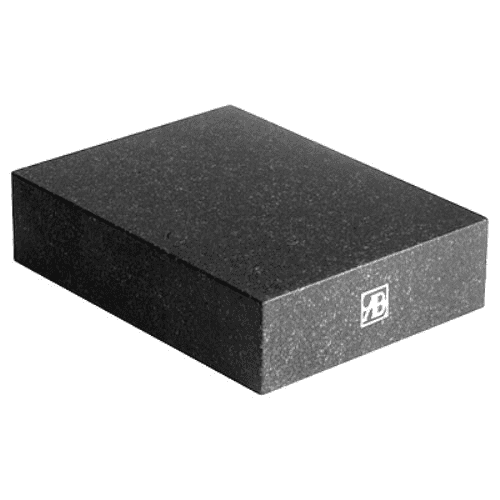
The purpose of a Surface Plate is to mimic a perfect second plane equally accurately every bit possible to facilitate other measurements being made on top that plane. Ane of the nearly common measurements is done with a Height Gauge (see above for details on height gauges).
Complete Guide to Surface Plates
Gauge Blocks (Gage Blocks, Johansson Gauges, Slip Gauges, Jo Blocks)
After the Surface Plate, Guess Blocks are probably the most common reference used by machinists. Here's a typical Mitutoyo Gauge Block Set:
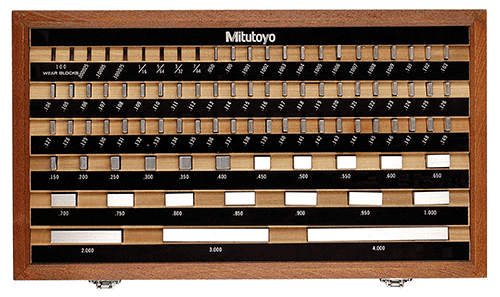
Each individual gauge block is made of either metal or ceramic that has been precision ground and lapped to a specific thickness with very great accuracy. Blocks can be stacked to brand up a specific length.
Joining gauge blocks together is a procedure called wringing. The ultra-flat surfaces cling together naturally. A normal set of xxx gauge blocks lets you lot take 3 blocks to make up any length from 3.000 to 3.999 mm in 0.001 mm steps (or 0.3000 to 0.3999 inches in 0.0001″ steps). That's pretty cool.
Gauge blocks are typically used as a reference for the calibration of other measurement tools. They were invented in 1896 past Swedish machinist Carl edvard Johansson, hence the name "Jo Blocks."
Now for the weird and wonderful–we don't actually know for sure exactly how wringing holds the blocks together. It is believed to be a combination of:
- Air pressure: All air is squeezed out betwixt the blocks so it's similar a vacuum force holding them together.
- Surface Tension from oil and water that is present between the blocks.
- Molecular attraction that occurs whenever two very flat surfaces come into contact. Since it is known that estimate blocks will stick together strongly fifty-fifty in a vacuum, these concluding two forces are believed to be the main cause.
In practice, you accept to wring two blocks together to feel the result. It'southward like 2 magnets that want to bond. And the force is quite strong. Here's a shot of 36 blocks wrung together and supporting their own weight:
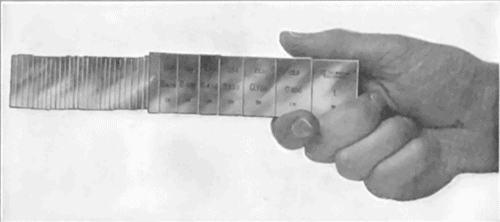
Gauge Blocks are typically used with two pads. One is oiled, and the other is clean. To wring ii blocks together:
- Wipe the clean blocks across the oiled pad.
- Wipe whatsoever actress oil off on the make clean pad.
- Slide ane block perpendicularly beyond the other.
- Once the block is in the middle of its travel, rotate it so it is aligned with the other block.
After employ, it is important to keep your Estimate Blocks clean of debris and contaminants, and oiled to preven corrosion.
If a block becomes dinged or damaged, it won't wring properly. You can gently rock the nick out to restore wringability.
Guess Block Grades
Every bit in many things Metrology oriented, in that location are different precision grades for Gauge Blocks. And, there are different formal specifications for these grades. Here are some typical grading systems described by Wikipedia:
- reference (AAA): Have the smallest tolerance (±0.05 μm) and are used to found standards
- scale (AA): (tolerance +0.10 μm to −0.05 μm) May be used to calibrate inspection blocks and very high precision gauging
- inspection (A): (tolerance +0.fifteen μm to −0.05 μm) May be used as toolroom standards for setting other gauging tools
- workshop (B): large tolerance (tolerance +0.25 μm to −0.xv μm) May exist used every bit store standards for precision measurement
Here are grade designations from U.S. Federal Specification GGG-Chiliad-15C:
- 0.5 — generally equivalent to grade AAA
- one — generally equivalent to grade AA
- 2 — generally equivalent to grade A+
- 3 — compromise form between A and B
and ANSI/ASME B89.1.9M, which defines both absolute deviations from nominal dimensions and parallelism limits every bit criteria for grade determination. Generally, grades are equivalent to quondam U.Due south. Federal grades as follows:
- 00 — by and large equivalent to grade 1 (virtually exacting flatness and accuracy requirements)
- 0 — generally equivalent to grade 2
- Equally-one — generally equivalent to class three (reportedly stands for American Standard – ane)
- Equally-2 — by and large less accurate than grade 3
- Grand — more often than not equivalent to grade 00 flatness (parallelism) with grade AS-1 accuracy
Achieving the level of accurateness these grades suggest will require careful temperature control as these tolerances are hands subject to thermal expansion.
Guess Block Materials
Gauge Blocks should be made of either hardened steel, tungsten carbide (much harder than steel), or ceramic. Hardness reduces wear during use and prolongs the life of the Gauge Blocks. Ceramic blocks take better thermal properties than metal Gauge Blocks.
Gage Block Figurer
Did you know we have a Free Cuff Block Estimator? It knows the standard sizes of gage blocks and will tell you which ones to wring together for a detail length.

Estimate Block Cost
You can spend thousands on a good gear up of high class gauge blocks from a name manufacturer. That'll be out of reach of many, too as more than you really need. Fortunately, you tin can get a decent fix of Course B (workshop quality) gauge blocks for as little as $82.99 on Amazon.
A higher quality Grade ii ready tin can be had for $168.00 on Amazon.
Those prices put Gauge Blocks within the attain of most CNC'ers.
Pin Gages (Pin Gauges, Guess Pins, Go / No-Go Gauges)
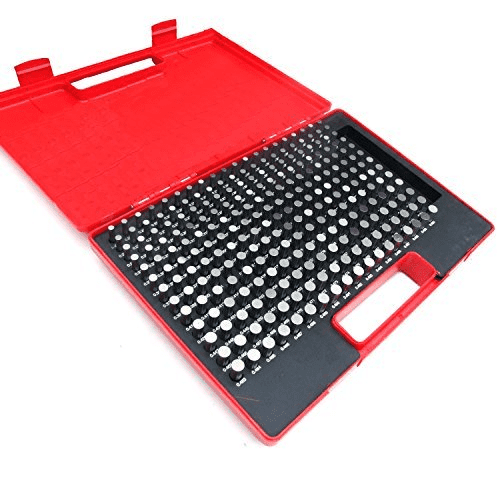
HFS 250 pc 0.251″ – 0.500″ M2 Class ZZ Steel Pivot Gauge Minus Fix. Most $93.99 on Amazon…
Pin Gauges are not as handy as Approximate Blocks, but they can still come up in plenty handy depending on your application. Pivot Gauges are cylinders that come up in precise sizes. Typically they are used to determine the diameter of small holes. The idea is to notice the largest pin size that volition drop into the hole unaided by any strength but gravity.
Gauge Pins come in different grades, with the most common being Form Z. They can be either "Plus" or "Minus" pins, and the most common are "Minus." A Course Z Minus Pin is toleranced to be -0.0002″. So, a 1.000″ Minus Pin is actually 0.9998″ in diameter.
Ane commonly uses a "Go" "No-Get" Pivot Setup. And so, for a hole that is specified as 0.150″ diameter, +0.004″ / -0.002″ tolerance, you'd use a Go Pivot of 0.152″ (largest pin that can fit) and a No-Go Pin of 0.154″. If the NoGo pin fits without interference, the part is oversized.
In other words, the office of a "Go" gauge is to fit the smallest adequate diameter, while the No-Go gauge is chosen to be big enough that it won't fit the largest acceptible bore. If the No-Become fits or the Become won't fit, the pigsty is out of tolerance.
Continue in mind that problems with Become/NoGo Pin fit may also be due to out of circular or surface finish problems with the pigsty.
Here's a nice video on the use of Gauge Pins:
Gauge Assurance
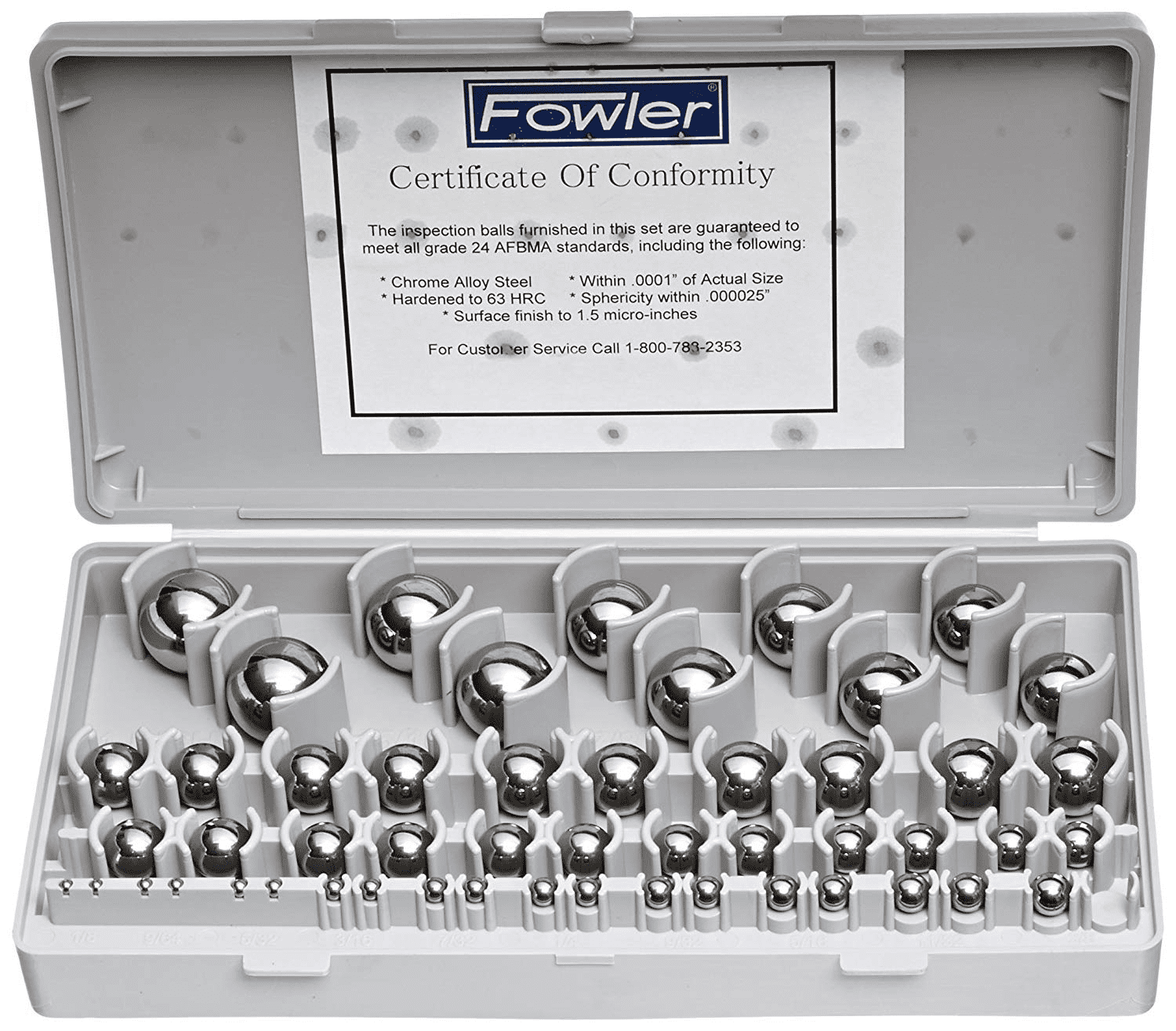
Fowler Gauge Brawl Set up, 52 slice. Nigh $71.02 on Amazon…
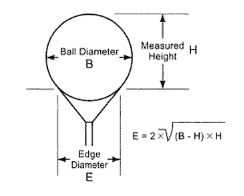
Gauge Balls, as the name suggests, are precision assurance in specific accurately fabricated diameters. They're handy for a diversity of applications, but typically you'll need to be a bit handy with math to apply them.
For case, this diagram shows how to utilise a Gauge Brawl to measure the major bore of a countersink:
As another example, consider using two Cuff Assurance to measure out a taper angle:
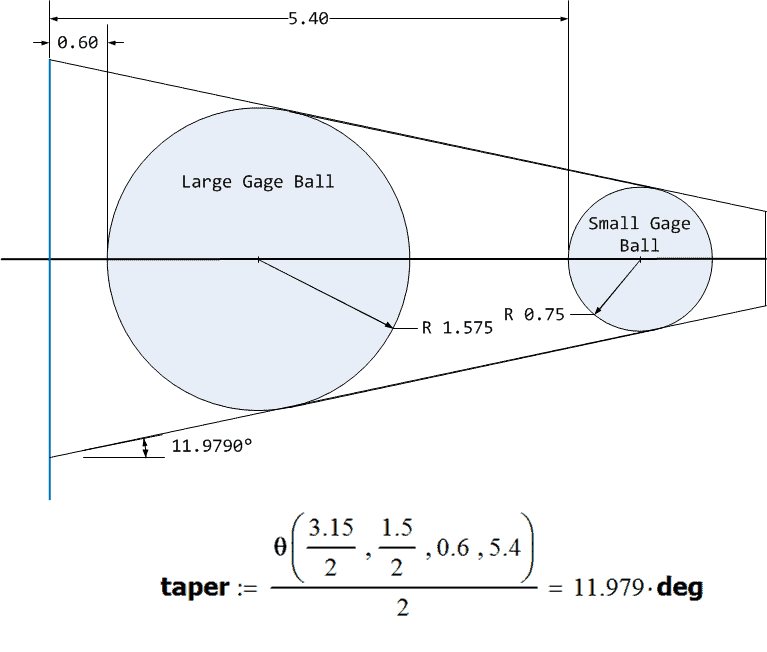
Example courtesy of Math Encounters Blog…
One tin likewise use Ball Gauges to mensurate the diameter of a diameter like this:
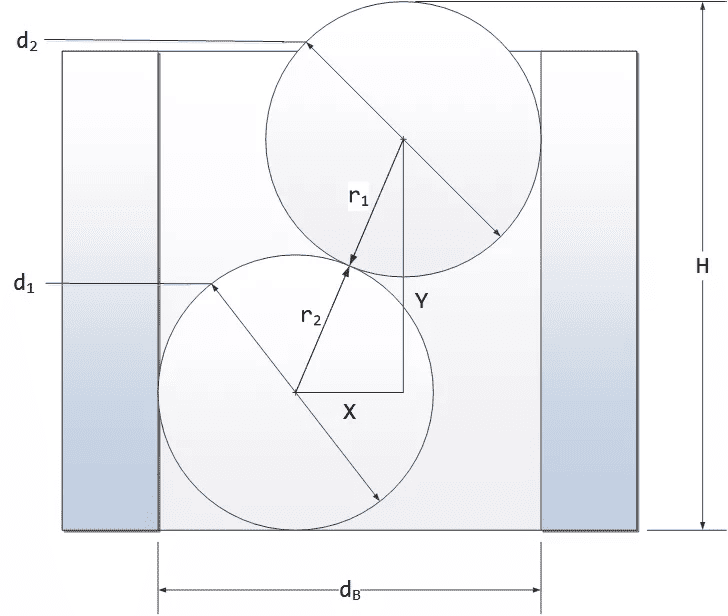
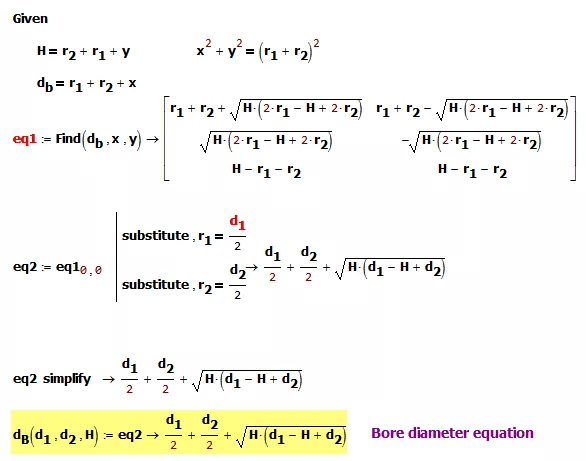
Diameter diameter example courtesy of Math Encounters Blog…
Angle-Related Measuring References
Cylindrical Square (Cylinder Square)
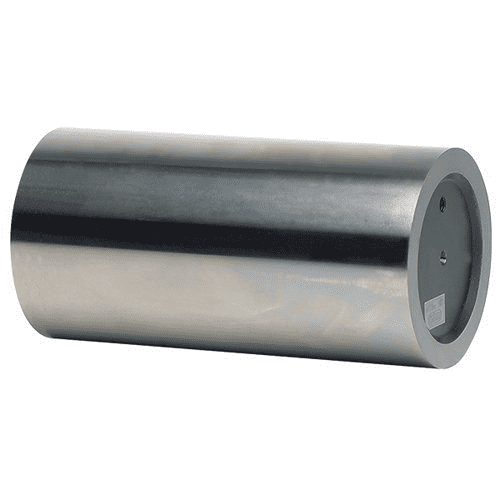
3″ x 6″ Cylindrical Square. Almost $169.99 on Amazon…
For certain kinds of Metrology tasks, Cylindrical Squares are handy. They're merely upright cylinders that are very accurately fabricated so that when they sit flat on a surface the cylinder'south circumference is truly perpendicular to that surface. The accurateness of the 6″ alpine square pictured is such that the peak edge is within 0.0001″ of where it should be.
Cylinder Squares are typically used to check and measure out squareness. For example, you could bank check the squareness of an angle plate by placing it on a surface plate adjacent to a cylinder square. If the contact is continuous for the whole contact surface area between the two, the angle plate is square. Smooth a calorie-free to show up whatever gaps and y'all tin tell to within a tenth (0.0001″) the squareness.
Another use is to have the foursquare be a standard while we sweep an indicator upwards and down the foursquare. For example, we can check the tram of a milling motorcar by placing the foursquare on the tabular array, a DTI in the spindle, and sweeping up and down the cylinder foursquare.
Here's a photo I took while checking squareness of a CNC Mill:
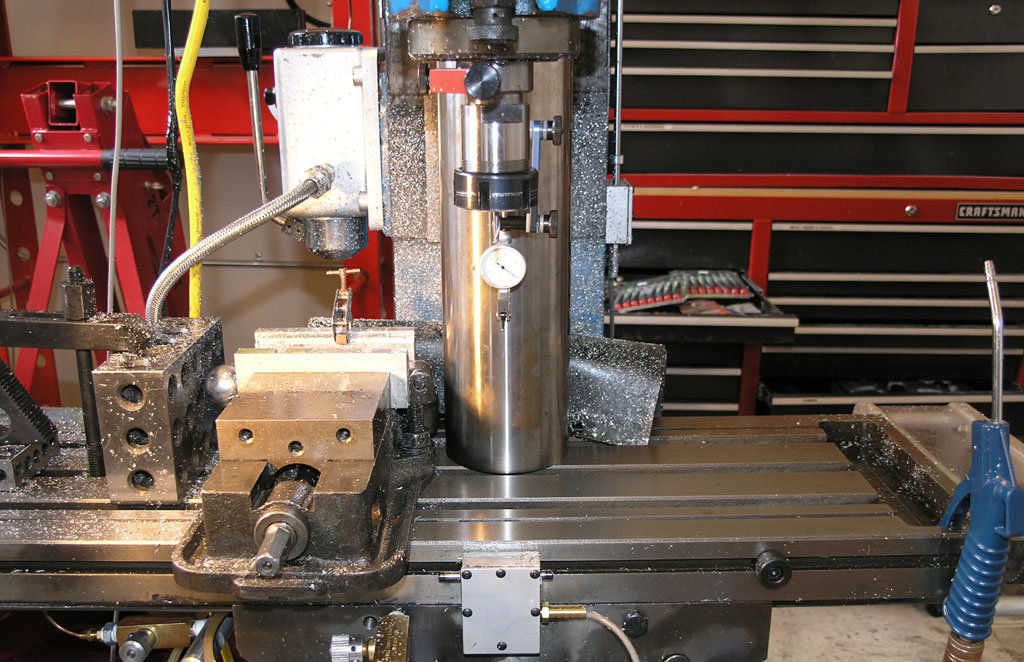
As you tin come across, the DTI is in the spindle, the square is flat on the tabular array (I cleaned that area before putting the square down) and I tin can evaluate how well the mill is in tram past raising or lowering the Z-axis and watching the behavior of the DTI.
Cylindrical Square Scale
Given the right measuring tools and a lapping plate, Cylindrical Squares tin exist corrected for errors pretty hands. Hither's a great video from Suburban Tool on how to calibrate and repair your cylindrical square:
Angle Plate
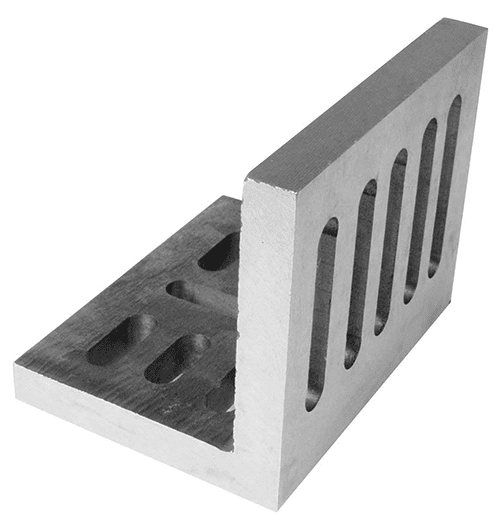
six″ x 5″ Cast Atomic number 26 Bending Plate. Most $50.79 on Amazon…
If y'all don't have a Cylinder Square, and I admit they are something of a luxury, your adjacent best bet is an Angle Plate. These are typically fabricated of cast atomic number 26, and are more commonly used for setups than for Metrology purposes.
Using the typical cast iron angle cake is pretty rough and tumble. The plate pictured higher up is but rated to 0.002″ per 6″. So that top border could be 0.002″ off what it should exist if the angle was perfect. That'southward pretty terrible for metrology purposes.
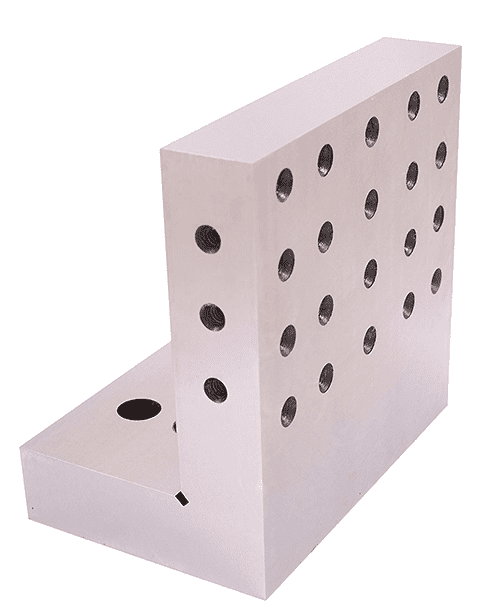
6″ x 6″ Footing Angle Plate. Near $182.28 on Amazon…
They practise make precision footing angle plate that are loftier accuracy but they're a lot more than money. Typically, they are made for grinding and other applications requiring high accurateness. The one pictured above is accurate to 0.0002″ at the top edge. That's about twice the cylinder square, but fashion amend than the cheaper angle plate.
You can, of course, buy higher quality angle plates for more than money than either of the models pictured here.
Precision Bending Blocks
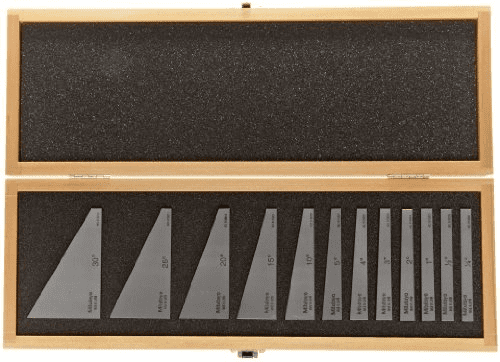
Precision Bending Block Prepare. Virtually $37.99 on Amazon…
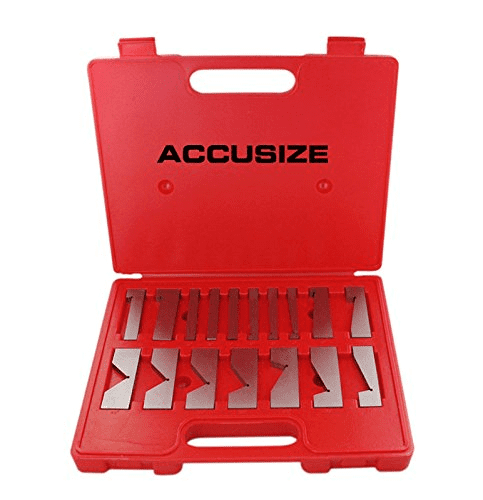
Precision Angle Block Set. About $86.40 on Amazon…
Suppose you lot want to setup a office quickly in your vise, only it needs to be cocked at a particular angle and not square?
Try some Precision Angle Blocks. They're the equivalent of Gauge Blocks for setting angles. Pretty dandy, eh?
Of the ii versions shown, I prefer the height style just because I tin more easily stack to brand up different angles.
1-2-3 Blocks and 2-iv-six Blocks
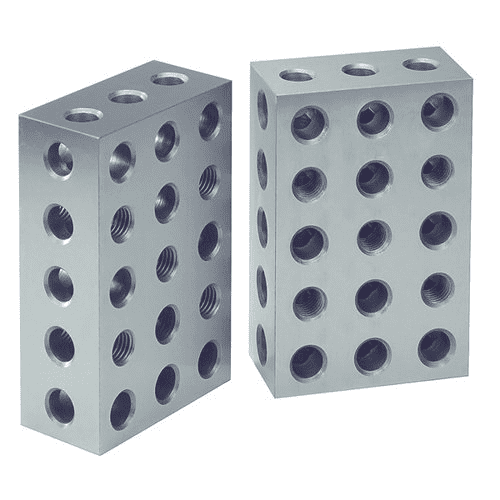
Precision ground ii-4-6 blocks. About $99.99 on Amazon…
And so you don't have a Cylinder Square or an Bending Plate that's accurately made enough to work. How to become things square? Your last avenue is to use your 1-ii-3 or 2-4-half-dozen Blocks. If they're accurately made, they should be square. The ones pictured above are spec'd to be within 0.00024″, which is non bad. If it were me, I am buying a nice set of 2-iv-6 blocks before any cylinder squares, bending plates, or precision angle blocks. They're just so darned useful for various setups.
Tip: Have you got a friend with a surface plate and cylinder square? Haul your bending plates, 1-two-three blocks, and two-4-six blocks over and check their squareness. You may exist very pleasantly surprised at how good they are. And if not, at least you'll know!
Feeler Gauges (Feeler Gage)
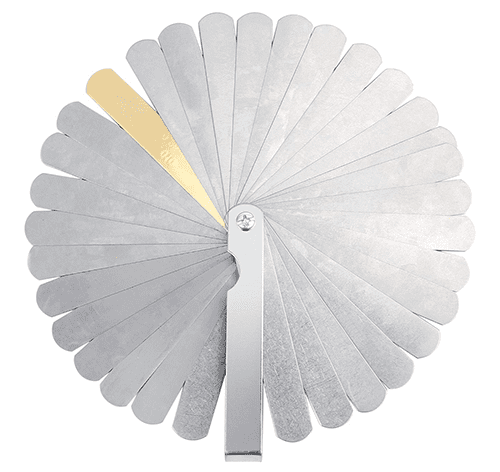
Imperial & Metric Feeler Estimate Set. About $five.95 from Amazon…
Feeler Gauges. You probably came across them for the first time as an assistance to setting spark plug gaps when working on your motorcar. But, they're besides viable metrology tools for measuring very small gaps.
Diameter Measuring Tools
Measuring Bores can be ane of the near hard CNC measuring chores. Nosotros've already seen how to use Pivot Gauges to measure small bores, simply what to do about larger bores?
Read on to discover the armory of tools that were developed for Bore Measurement.
Telescoping Hole Gages (Snap Gages)
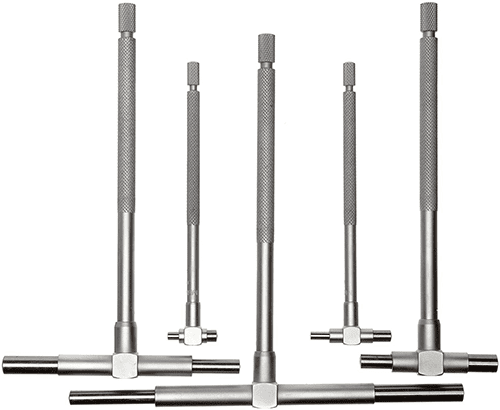
Mitutoyo Telescoping Gage Set up for ane/2″ to 6″ holes. Nigh $152.99 on Amazon…
A set of Telescoping Gages is one of the starting time bore measuring tools most CNC'ers acquire. The Mitutoyo set up I take featured in a higher place is more expensive than what most machinists buy, only at that place is a method to the madness. You run across, it takes a fair bit of touch and technique to apply Telescoping Gages successfully. Having a nicer set of Gages helps, because they have ameliorate feel, though you will still need to do your technique until it is accurate and repeatable.
Telescoping Gage Accuracy
If y'all know what you're doing, and it takes a ton of practice, you can measure mensurate bore diameters to within a few tenths. Read on to be sure yous sympathize what it takes to principal these gadgets.
How to Utilise Telescoping Gages
The thought behind Telescoping Gages is yous insert them into the bore. The bore causes them to retract, then y'all withdraw them and measure the end to end distance between the contact points with a micrometer. The cease of the handle has a knurled knob that controls a lock.
Sounds easy, right? Except you've got to make the measurement while keeping the Gages across a truthful diameter and not artsy in any way. In practice, this is done with a sort of rocking motility and simultaneous employ of the lock.
I refer you to one of Suburban Tool'southward excellent videos to encounter just how it'south done:
Ideally, get a few unlike bores to play with whose size you know very accurately. Try working the feel with your eyes closed until y'all can get repeatable authentic measurements.
Brawl Gages
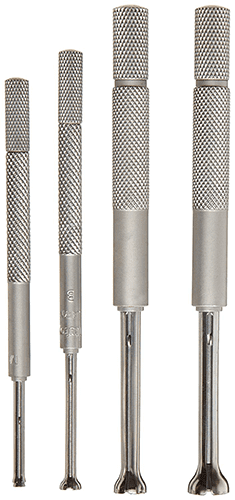
Mitutoyo Brawl Gage prepare, 3mm to 13mm. Near $106.00 on Amazon…
Brawl Gages are a shut cousin to Telescoping Gages that are intended for smaller bores.
Punch Bore Cuff (dial bore gauge)
If I left you with the impression that telescoping gages can exist hard to apply consistently, practiced, because it's true. So what practise you exercise if you want an easier, albeit much more expensive method of measuring bores?
Commonly the answer is to utilize a Dial Bore Gauge. Here's a beautiful (if costly) Mitutoyo Dial Bore Gage set:
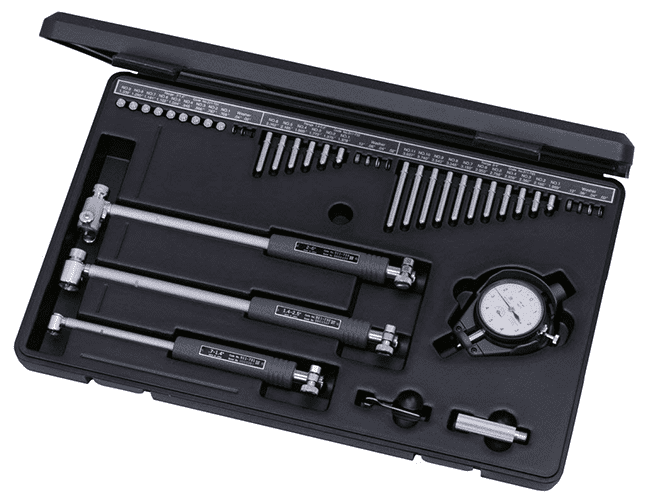
Mitutoyo Dial Bore Gauge Prepare, 0.7″ to 6″ range. Almost $875.xiv on Amazon…
In practice, you prepare the gauge up with the right anvils and other zipper for your bore's size, insert it in the bore, and gently stone information technology to get the maximum reading of the diameter.
Dial Diameter Gauge Accuracy
A good dial bore gauge is good to perhaps a few tenths, and they're faster and require much less touch than telescoping gages.
Ouch, what virtually the cost?
In that location are a few means to become your hands on dial diameter gauges without totally breaking the banking company. First, you could merely purchase sizes as needed. A single size Mitutoyo Dial Bore Gauge is less than half the cost of the set. 2d, you lot could haunt eBay until a used model comes upward at a decent price. Lastly, you could investigate cheaper brands.
Brands similar Fowler price 1/3 to less what the Mitutoyos become for.
Indi-Calipers
These are a groovy shopmade tool for accurately measuring bores:
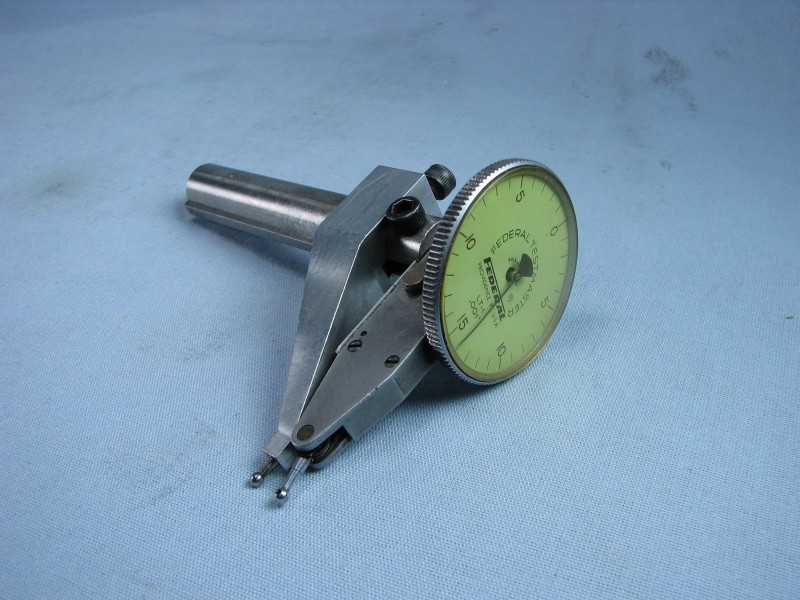
I've written an article about Indi-Calipers with more details, simply the thought is pretty simple. You've got 2 adjustable points with one end existence a DTI. Conform to the nearest reference (for example using a mic), the read off the departure on the DTI when y'all probe the diameter with the Indi-Caliper.
Simple, authentic, and relatively inexpensive compared to Dial Bore Gauges.
Ring Gages (outside gages)
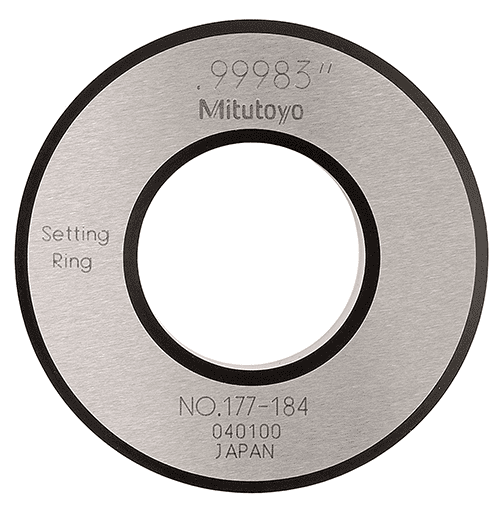
Mitutoyo Ring Cuff, one.000″, +/- 0.00004″. About $192 on Amazon…
Ring Gauges are useful for measuring diameters and for calibrating ID bore measurement tools. They're often the "gold standard" for such scale, in fact.
Hole Micrometer (Brownish & Sharpe Intrimik, Mitutoyo Holtest, Fowler Holemike, Tubular Inside Micrometer, Diameter Gage)
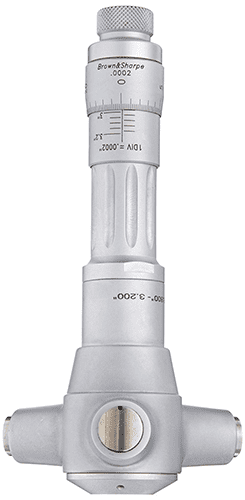
Brown & Sharpe Intrimik Inside Micrometer, 2.8-three.2″ Range. Near $277.10 on Amazon.
Inside Micrometers come in a variety of styles and tradenames. Pictured is one of the classics, a Dark-brown & Sharpe Intrimik. It has 3 measuring anvils that encounter the bore, and so it is less susceptible to the types of errors caused by 2 point measuring instruments.
Some three-point mics also space the mics asymmetrically, such as the Etalon make. The purpose of this is to permit multiple readings to determine the roundness of the diameter.
Many prefer a Dial Bore Guess to these inside mics, considering the measurement is afflicted less by heat transfer from the hand holding the instrument. They do make clamp on handles for these mics to minimize the heat transfer. A good three-bespeak within micrometer with the handle is typically a bit more accurate than a punch diameter judge.
Tip: Information technology'due south a proficient do to use an outside mic to verify the measurement of an within mic assuming you have a diametral reading and not a 3-point within mic.
Go No-Become Gauges
Nosotros talked a flake about Go No-Go Gauges in the section on pivot gauges where we described how to utilize pin gauges for Go No-Go. For convenience, we gave this instance:
For a hole that is specified as 0.150″ diameter, +0.004″ / -0.002″ tolerance, you'd use a Go Pivot of 0.152″ (largest pivot that can fit) and a NoGo Pin of 0.154″. If the NoGo pin fits without interference, the part is oversized.
In other words, the role of a "Go" gauge is to fit the smallest acceptable diameter, while the NoGo gauge is chosen to be large enough that it won't fit the largest acceptible diameter. If the NoGo fits or the Become won't fit, the hole is out of tolerance.
Go along in mind that bug with Go/NoGo Pin fit may also be due to out of round or surface end problems with the hole.
Here'south some other mode of Go No-Go Gauge that one frequently sees in automobile shops:
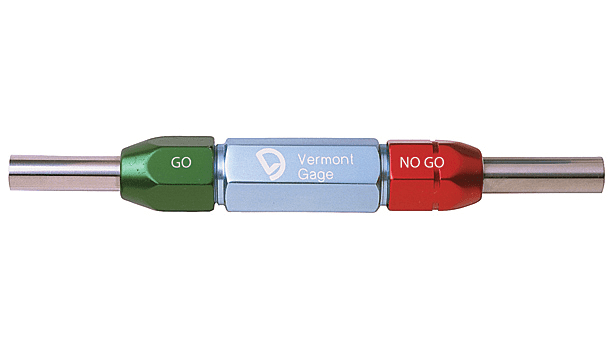
Notation how the pins are kept together and the "Go" and "No Go" ends are clearly marked and colour coded.
Angle Measuring Tool (Angle Measuring Devices, Bending Measuring Instruments)
Precision angle measurement may exist concerned with either leveling or the bodily measurement of an angle as a feature on a part, fixture, or other component in a machine shop.
Machinists Levels (Precision Levels)
Well-nigh machinery works better if it is leveled when installed. The preferred tool for leveling is a machinist'southward level, and at that place are both one-time-way and new digital tools available.
Here's the slick digital version:
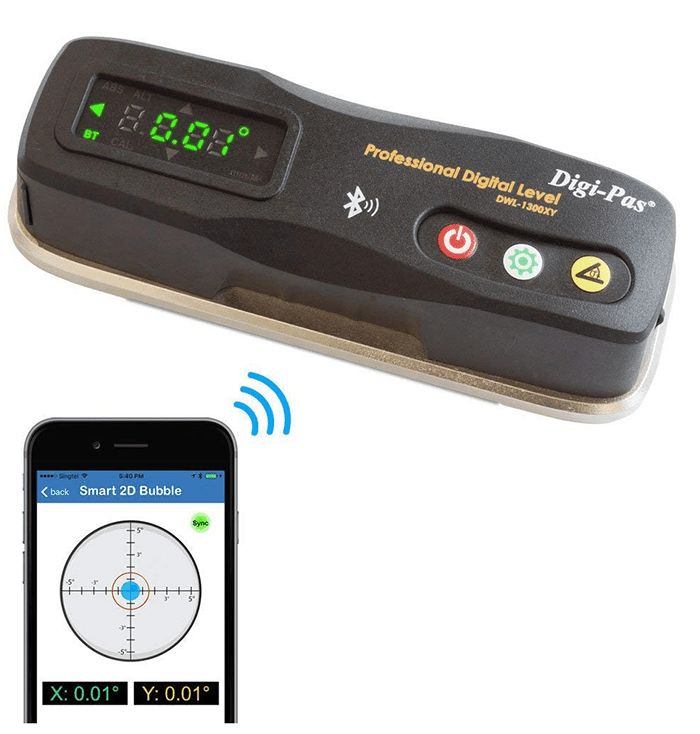
Digi-Pas Digital Level. About $239 on Amazon…
Note how it even has a telephone app to aid.
And here is the one-time-fashioned analog precision level from Starrett:
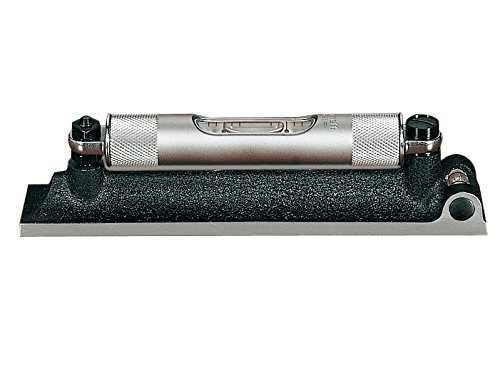
Starrett 6″ Precision Level. About $131 on Amazon…
I own a Starrett level like that and have used information technology to level all of my CNC Machines. It works great, merely clearly the digital version has a lot more than bells and whistles for non a lot more than coin. If the digital level had been available when I bought the Starrett years agone, I probably would've gone digital. If nothing else, the digital protractor part of the digital level would sure be handy a lot of times.
Digital Protractor (Inclinometer)
Speaking of Digital Protractors, they're readily available, and yeah, I've got a inexpensive i that I use from time to time. Mine is similar to this model:
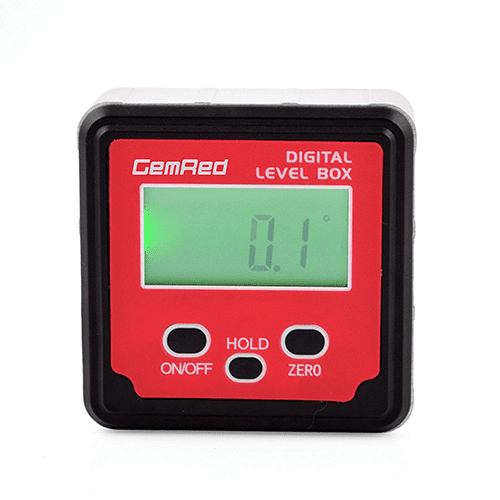
GemRad Digital Protractor and Inclinometer. Most $25.99 on Amazon…
These inexpensive inclinometers are handy, but I don't know how much I trust their accuracy versus a unit fabricated for the machinist market similar the Digi-Pas.
Sine Bar, Sine Plate & Sine Vise
We give the Sine Bar, Sine Plate, and Sine Vise a special identify in angle measurement because they're used both for measuring and for fixturing when specific angles other than 90 degrees are important to brand a part correctly.
Here'south a typical Sine Bar:
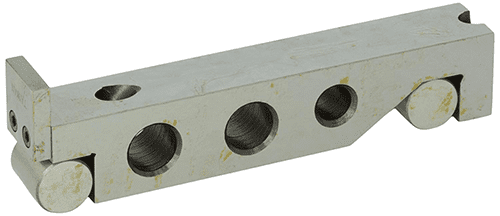
Fowler Sine Bar. About $145 on Amazon…
Nosotros've put together a complete guide to Sine Confined, Sine Plates, and Sine Vises for you. Information technology fifty-fifty includes a gratis Sine Bar Calculator:
Complete Guide to Sine Bar, Sine Plate & Sine Vise with Free Calculator
Thread Measuring Tools
Spiral Thread Micrometer
It should come as no surprise that screw threads are fickle beasts that accept lots of measurements requiring a degree of precision. The cheap method is to use three wires. The more user-friendly and probably more authentic method is to use a Screw Thread Micrometer:
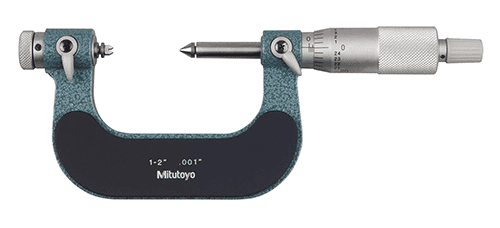
Spiral Thread Micrometers have interchangeable tips because they have to match the angle of threads. For a source of all the fundamental dimensional data on thousands of threads, check out our G-Wizard Thread Estimator.
Thread Pitch Gages
Thread Pitch Gauges can quickly tell y'all the pitch of an external thread:
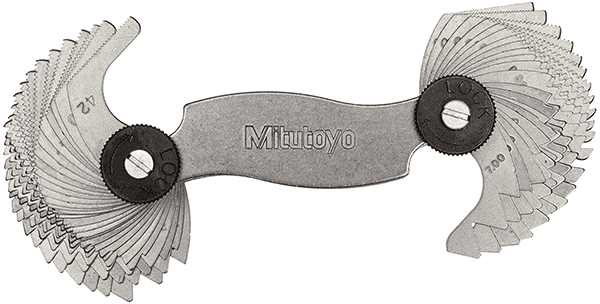
Mitutoyo Thread Pitch Judge. Nearly $47 on Amazon…
Each leaf has a set of serrations that match the teeth of the thread to help you decide what the thread pitch is.
3-wire Thread Measurement
3 Wire Thread Measurement is the most mutual mode to accept precision thread measurements. The iii wires go into the teeth of an external thread and are measured by a micrometer like this:
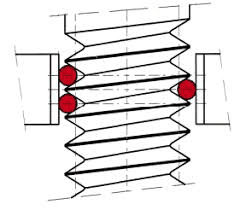
Given the bore of the wires and the measurement with the micrometer, the thread's pitch diameter tin be determined very accurately.
Iii Wire Calculator or Information Tables
Converting a three wire measurement to a pitch diameter requires either data tables or a three wire calculator. Our G-Wizard Thread Calculator has a built-in three wire calculator that covers thousands of thread profiles:
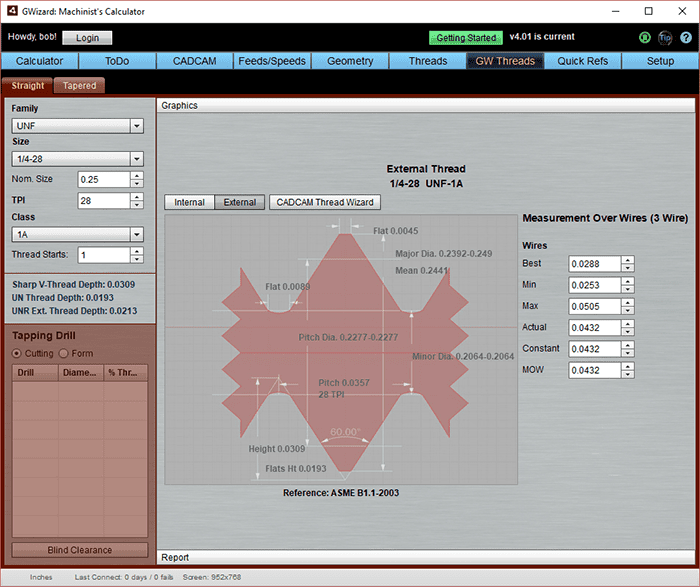
For a given thread, information technology'll tell y'all the preferred wires and what the MOW (Measurement Over Wires) should be if the thread is correct.
3 Wire Thread Measurement Sets
The precision wires used for Three Wire Thread Measurement come in sets of standard sizes like this:
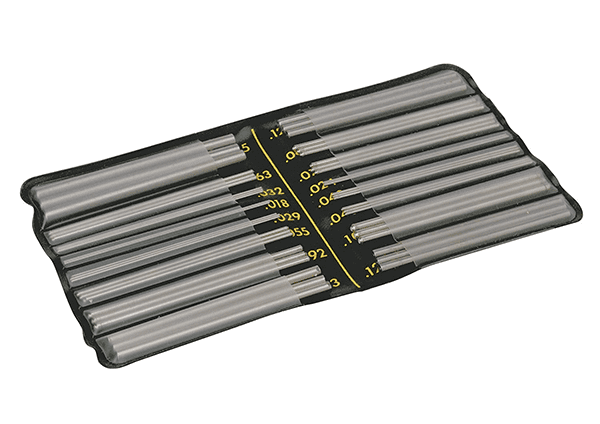
Chocolate-brown & Sharpe Three Wire Thread Measurement Set. About $35 on Amazon…
Surface Roughness Measurement
Surface Roughness is one aspect of Surface Finish.
Here's a nautical chart tabular array showing the relative surface roughness of various manufacturing processes:
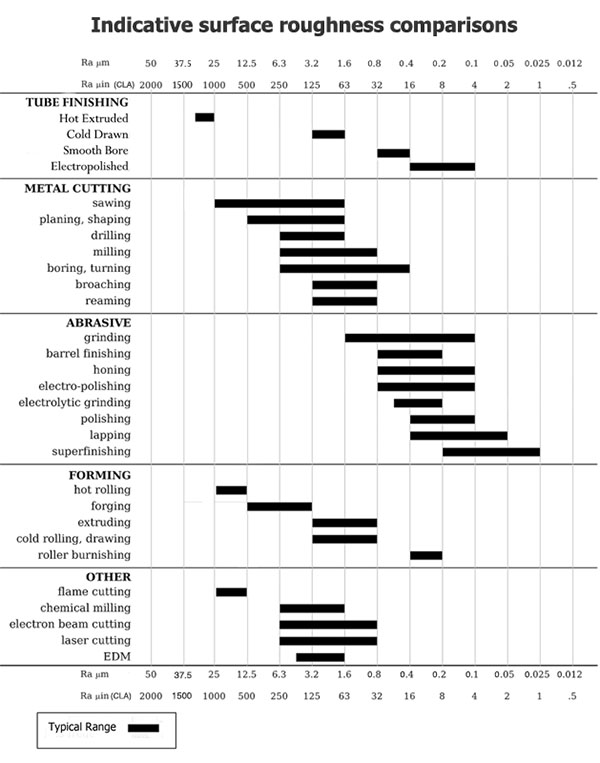
Relative Surface Finish Roughness of Manufacturing Processes…
For more than on measuring Surface Roughness likewise equally units for expressing Surface Roughness that nosotros embrace in our detailed Surface Finish article.
Complete Guide to Surface Finish
Optical Metrology (Optical Measurement)
Optical Comparator
Optical Flats
Coordinate Measuring
What is a CMM Machine?
Imagine a CNC-fashion machine capable of making extremely precise measurements in a highly automated style. That'southward what CMM Machines do!

Hexagon Global Archetype CMM, a typical coordinate measurement machine…
CMM stands for "Coordinate Measuring Machine". They're possibly the ultimate 3D measuring devices in terms of their combination of overall flexibility, accuracy, and speed.
Check out our Complete Guide to Coordinate Measuring Machines for much more than on these powerful metrology tools.
Laser Metrology (Laser Measuring Tool, Light amplification by stimulated emission of radiation Measuring Devices)
3D Touch Probes
Measurement for Reverse Engineering science
Use your Automobile every bit a CMM
Accurately Measuring Altitude Between Two Hole Centers
Calibration and Traceability
approximate calibration
micrometer calibration
metrological traceability
nist traceable calibration
caliper calibration
guess cake calibration
hardness tester calibration
Metrology Software
Source: https://www.cnccookbook.com/metrology-machinist-tools-complete-guide/

Post a Comment for "3d drawing of a planer-shaper gauge"