Romans Brought Art Such as Obelisks Back With Them After Their Military Conquests
With the lands of Greece, Egypt, and across, Ancient Rome was a melting pot of cultures.
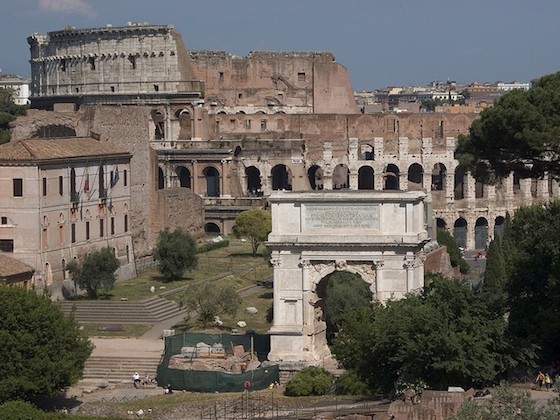
View of the Roman forum, looking toward the Colosseum (photo: Steven Zucker, CC Past-NC-SA two.0)
Roman art: when and where
Roman fine art is a very wide topic, spanning almost 1,000 years and three continents, from Europe into Africa and Asia. The first Roman art tin be dated back to 509 B.C.Eastward., with the legendary founding of the Roman Commonwealth, and lasted until 330 C.E. (or much longer, if you include Byzantine art). Roman art as well encompasses a broad spectrum of media including marble, painting, mosaic, gems, silverish and bronze piece of work, and terracottas, just to name a few. The city of Rome was a melting pot, and the Romans had no qualms about adapting artistic influences from the other Mediterranean cultures that surrounded and preceded them. For this reason information technology is common to run across Greek, Etruscan and Egyptian influences throughout Roman fine art. This is non to say that all of Roman art is derivative, though, and one of the challenges for specialists is to define what is "Roman" near Roman art.

Doryphoros (Spear Bearer), Roman copy afterwards an original by the Greek sculptor Polykleitos from c. 450-440 B.C.East., marble, six'six″ (Archaeological Museum, Naples) (photograph: Steven Zucker, CC Past-NC-SA 2.0)
Greek art certainly had a powerful influence on Roman practise; the Roman poet Horace famously said that "Greece, the captive, took her roughshod victor convict," pregnant that Rome (though it conquered Greece) adapted much of Greece'southward cultural and artistic heritage (besides as importing many of its most famous works). It is also true that many Romans deputed versions of famous Greek works from earlier centuries; this is why we often take marble versions of lost Greek bronzes such every bit the Doryphoros past Polykleitos.
The Romans did not believe, equally we do today, that to have a copy of an artwork was of any less value that to accept the original. The copies, nevertheless, were more often variations rather than direct copies, and they had small changes made to them. The variations could be made with humor, taking the serious and somber element of Greek fine art and turning information technology on its head. So, for example, a famously gruesome Hellenistic sculpture of the satyr Marsyas beingness flayed was converted in a Roman dining room to a knife handle (currently in the National Archaeological Museum in Perugia). A pocketknife was the very element that would have been used to flay the poor satyr, demonstrating not only the owner's knowledge of Greek mythology and of import statuary, just also a nighttime sense of humor. From the direct reporting of the Greeks to the utilitarian and humorous luxury item of a Roman enthusiast, Marsyas made quite the journey. Just the Roman artist was non simply copying. He was also adapting in a conscious and brilliant way. It is precisely this ability to adapt, convert, combine elements and add together a touch on of humor that makes Roman art Roman.
Republican Rome
The mythic founding of the Roman Democracy is supposed to have happened in 509 B.C.E., when the final Etruscan king, Tarquinius Superbus, was overthrown. During the Republican period, the Romans were governed by annually elected magistrates, the ii consuls beingness the most important among them, and the Senate, which was the ruling body of the state. Eventually the system broke downwardly and ceremonious wars ensued betwixt 100 and 42 B.C.E. The wars were finally brought to an finish when Octavian (subsequently called Augustus) defeated Mark Antony in the Battle of Actium in 31 B.C.Due east.

Marble bust of a man, mid 1st century, marble, fourteen 3/viii inches (The Metropolitan Museum of Art)
In the Republican period, art was produced in the service of the land, depicting public sacrifices or jubilant victorious military campaigns (like the Monument of Aemilius Paullus at Delphi). Portraiture extolled the communal goals of the Republic; hard work, age, wisdom, being a customs leader and soldier. Patrons chose to have themselves represented with balding heads, large noses, and extra wrinkles, demonstrating that they had spent their lives working for the Democracy every bit model citizens, flaunting their acquired wisdom with each furrow of the brow. We now telephone call this portrait way veristic, referring to the hyper-naturalistic features that emphasize every flaw, creating portraits of individuals with personality and essence.
Imperial Rome
Augustus's rise to power in Rome signaled the end of the Roman Republic and the formation of Imperial rule. Roman art was at present put to the service of aggrandizing the ruler and his family. Information technology was also meant to signal shifts in leadership. The major periods in Imperial Roman art are named after individual rulers or major dynasties, they are:
Augustan (27 B.C.E.-14 C.E.)
Julio-Claudian (xiv-68 C.Eastward.)
Flavian (69-98 C.E.)
Trajanic (98-117 C.E.)
Hadrianic (117-138 C.Due east.)
Antonine (138-193 C.Due east.)
Severan (193-235 C.E.)
Soldier Emperor (235-284 C.E.)
Tetrarchic (284-312 C.E.)
Constantinian (307-337 C.Due east.)

Relief from the Ara Pacis Augustae (Altar of Augustan Peace), nine B.C.Eastward. monument is dedicated, marble (Museo dell'Ara Pacis, Rome) (photo: Steven Zucker, CC BY-NC-SA 2.0)
Imperial art often hearkened dorsum to the Classical fine art of the past. "Classical", or "Classicizing," when used in reference to Roman art refers broadly to the influences of Greek art from the Classical and Hellenistic periods (480-31 B.C.Due east.). Classicizing elements include the smoothen lines, elegant drapery, arcadian nude bodies, highly naturalistic forms and counterbalanced proportions that the Greeks had perfected over centuries of practice.

Augustus of Primaporta, 1st century C.Due east. (Vatican Museums) (photo: Steven Zucker, CC By-NC-SA 2.0)
Augustus and the Julio-Claudian dynasty were specially fond of adapting Classical elements into their fine art. The Augustus of Primaporta was made at the stop of Augustus's life, yet he is represented as youthful, idealized and strikingly handsome like a young athlete; all hallmarks of Classical art. The emperor Hadrian was known equally a philhellene, or lover of all things Greek. The emperor himself began sporting a Greek "philosopher's bristles" in his official portraiture, unheard of earlier this time. Décor at his rambling Villa at Tivoli included mosaic copies of famous Greek paintings, such as Battle of the Centaurs and Wild Beasts past the legendary ancient Greek painter Zeuxis.
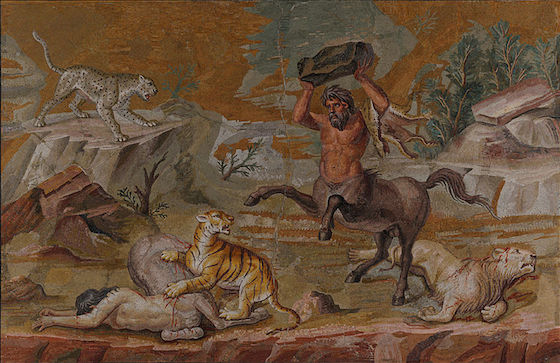
Pair of Centaurs Fighting Cats of Prey from Hadrian'due south Villa, mosaic, c. 130 C.Eastward. (Altes Museum, Berlin)
Later Imperial art moved abroad from before Classical influences, and Severan fine art signals the shift to fine art of Late Artifact. The characteristics of Late Antique art include frontality, stiffness of pose and drapery, deeply drilled lines, less naturalism, squat proportions and lack of individualism. Important figures are ofttimes slightly larger or are placed above the rest of the oversupply to denote importance.

Chariot procession of Septimus Severus, relief from the attach of the Arch of Septimus Severus, Leptis Magna, Libya, 203 C.E., marble, five; 6" high (Castle Museum, Tripoli)
In relief panels from the Arch of Septimius Severus from Lepcis Magna, Septimius Severus and his sons, Caracalla and Geta ride in a chariot, marking them out from an otherwise compatible sea of repeating figures, all wearing the same stylized and apartment drapery. There is little variation or individualism in the figures and they are all stiff and carved with deep, full lines. There is an ease to reading the work; Septimius is centrally located, between his sons and slightly taller; all the other figures straight the viewer'south optics to him.

Relief from the Arch of Constantine, 315 C.E., Rome (photograph: F. Tronchin, CC Past-NC-ND two.0)
Constantinian art continued to integrate the elements of Late Artifact that had been introduced in the Severan period, but they are now developed even farther. For instance, on the oratio relief panel on the Curvation of Constantine, the figures are even more than squat, frontally oriented, similar to i some other, and there is a clear lack of naturalism. Again, the message is meant to exist understood without hesitation: Constantine is in power.
Who made Roman art?
We don't know much nearly who fabricated Roman fine art. Artists certainly existed in artifact but we know very little about them, specially during the Roman menstruum, because of a lack of documentary evidence such as contracts or messages. What evidence we do have, such as Pliny the Elderberry's Natural History, pays little attention to contemporary artists and oft focuses more on the Greek artists of the past. Equally a result, scholars do not refer to specific artists but consider them generally, equally a largely bearding group.

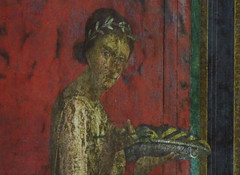
Painted Garden, removed from the triclinium (dining room) in the Villa of Livia Drusilla, Prima Porta, fresco, thirty-20 B.C.E. (Museo Nazionale Romano, Palazzo Massimo, Rome)
What did they make?
Roman art encompasses private art made for Roman homes as well equally art in the public sphere. The elite Roman habitation provided an opportunity for the owner to brandish his wealth, taste and education to his visitors, dependents, and clients. Since Roman homes were regularly visited and were meant to be viewed, their decoration was of the utmost importance. Wall paintings, mosaics, and sculptural displays were all incorporated seamlessly with small luxury items such as bronze figurines and silverish bowls. The subject thing ranged from busts of important ancestors to mythological and historical scenes, still lifes, and landscapes—all to create the idea of an erudite patron steeped in culture.

Ludovisi Battle Sarcophagus: Boxing of Romans and Barbarians, c. 250-260 C.Eastward., preconneus marble, 150 cm loftier (Palazzo Altemps: Museo Nazionale Romano, Rome).
When Romans died, they left backside imagery that identified them as individuals. Funerary imagery frequently emphasized unique physical traits or merchandise, partners or favored deities. Roman funerary art spans several media and all periods and regions. It included portrait busts, wall reliefs fix into working-form group tombs (like those at Ostia), and elite decorated tombs (like the Via delle Tombe at Pompeii). In addition, there were painted Faiyum portraits placed on mummies and sarcophagi. Considering death touched all levels of guild—men and women, emperors, elites, and freedmen—funerary art recorded the diverse experiences of the various peoples who lived in the Roman empire

Column of Trajan, Carrera marble, completed 113 C.Eastward., Rome, dedicated to Emperor Trajan in honor of his victory over Dacia (at present Romania) 101-02 and 105-06 C.E. (photo: Steven Zucker, CC By-NC-SA ii.0)
The public sphere is filled with works commissioned by the emperors such every bit portraits of the imperial family or bath houses decorated with copies of of import Classical statues. There are also commemorative works similar the triumphal arches and columns that served a didactic too every bit a celebratory function. The arches and columns (like the Arch of Titus or the Cavalcade of Trajan), marked victories, depicted state of war, and described military machine life. They also revealed foreign lands and enemies of the state. They could also describe an emperor'south successes in domestic and strange policy rather than in war, such as Trajan's Arch in Benevento. Religious fine art is too included in this category, such as the cult statues placed in Roman temples that stood in for the deities they represented, similar Venus or Jupiter. Gods and religions from other parts of the empire also fabricated their way to Rome's capital including the Egyptian goddess Isis, the Persian god Mithras and ultimately Christianity. Each of these religions brought its ain unique sets of imagery to inform proper worship and instruct their sect's followers.
Information technology tin can be difficult to pinpoint just what is Roman near Roman art, but it is the ability to adapt, to take in and to uniquely combine influences over centuries of do that made Roman fine art singled-out.
Additional resource:
Clarke, John R. Art in the Lives of Ordinary Romans: Visual Representation and Non-Elite Viewers in Italian republic, 100 B.C-A.D. 315. Los Angeles: Academy of California Press, 2003.
Kleiner, Fred S. A History of Roman Art. Belmont: Thomson Wadsworth, 2007.
Ramage, Nancy H., and Andrew Ramage. Roman Art: Romulus to Constantine. Fifth Edition. New Jersey: Prentice Hall, Inc., 2008.
Stewart, Peter. The Social History of Roman Art. New York: Cambridge University Printing, 2008.
Zanker, Paul. Roman Fine art. Los Angeles: J. Paul Getty Museum, 2010.
Smarthistory images for teaching and learning:





More Smarthistory images…
Source: https://smarthistory.org/introduction-to-ancient-roman-art/

Post a Comment for "Romans Brought Art Such as Obelisks Back With Them After Their Military Conquests"